  |
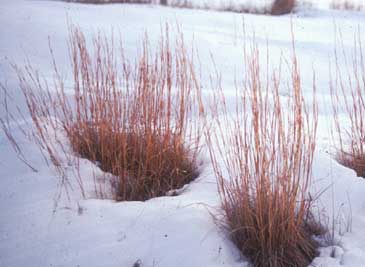
Grasslands have deep soils that are very nutrient rich because of the large amount of plant tissue ('biomass') that dies off and is added to the soil through decomposition every year. This is why grassland is often converted into farmland, which has been the case for most grassland in Ontario. Often grassland soil contains a large proportion of clay, which retains moisture better than sandy soils so that plants growing there can put on a great deal of growth in the spring when there is more rain. Grasslands occur where there is less rain than many other ecosystems in the summer and fall (true prairie is adapted to conditions where evaporation exceeds precipitation). Plants living in grasslands must be adapted to taking advantage of spring rains to grow and also to tolerating dry summer conditions (drought). Grasses have very deep and extensive root systems that can reach down to get water and they lose less water through their leaves than many other plant types. Grasslands are good at using winter snow as insulation. Because there are so many plants the snow gets trapped amongst the leaves and stems. This snow cover protects the plants and also provides water in spring when the snow melts.  |
|
